DoA processing in the FMCW TDM-MIMO chain
The figure below shows an example of a frame-level processing chain for FMCW TDM-MIMO radar.
It highlights where direction-of-arrival (DoA) estimation is applied after range–Doppler processing, TDM-MIMO correction, and target detection.
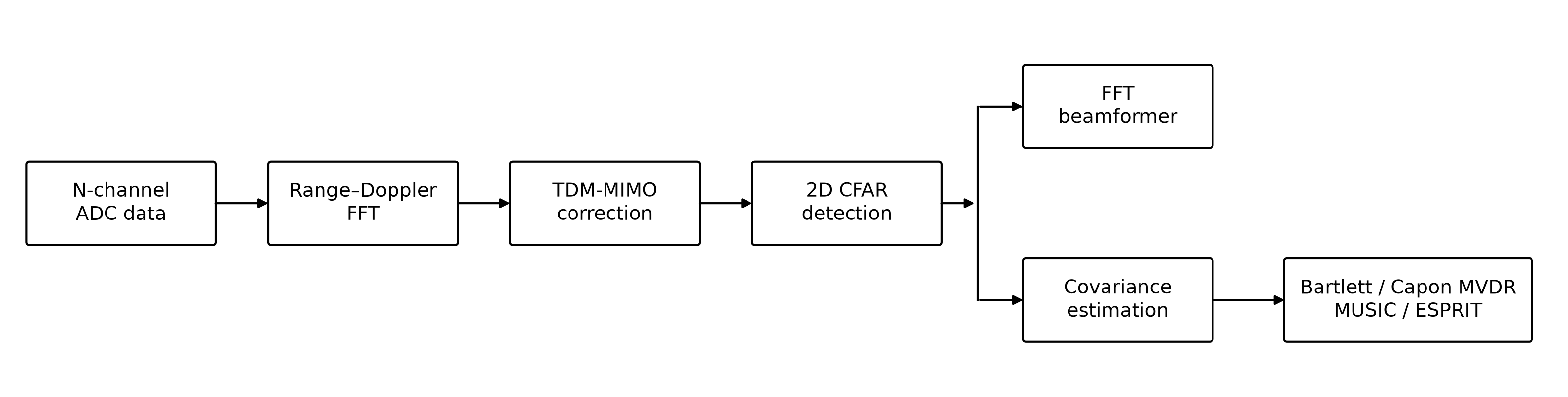
This is only one possible processing flow. In practical radar systems, the chain may vary depending on the signal model, detection strategy, and selected DoA algorithm.
Snapshot extraction for covariance estimation
A snapshot is the complex signal vector across the virtual antenna channels for a selected Range–Doppler location. Several strategies can be used to collect snapshots for covariance-matrix estimation:
- One snapshot per frame: the same detected Range–Doppler cell is extracted from several consecutive frames, and the covariance matrix is formed across time.
- Range–Doppler neighborhood: snapshots are taken from adjacent Range–Doppler cells within the same frame. The neighborhood may extend in both dimensions or only along range or Doppler. This allows the covariance matrix to be updated every frame.
- Overlapping subarrays: snapshots are generated from shifted subarrays of the virtual antenna array. This spatial-smoothing approach also enables covariance estimation within each frame.
The selected method determines the number of available snapshots, update rate, angular aperture, and underlying signal assumptions.
One snapshot per frame
For a detected target, the complex samples from the same Range-Doppler cell are extracted across consecutive frames. Each frame contributes one spatial snapshot across the virtual antenna channels, while the covariance matrix is updated after collecting several frames.
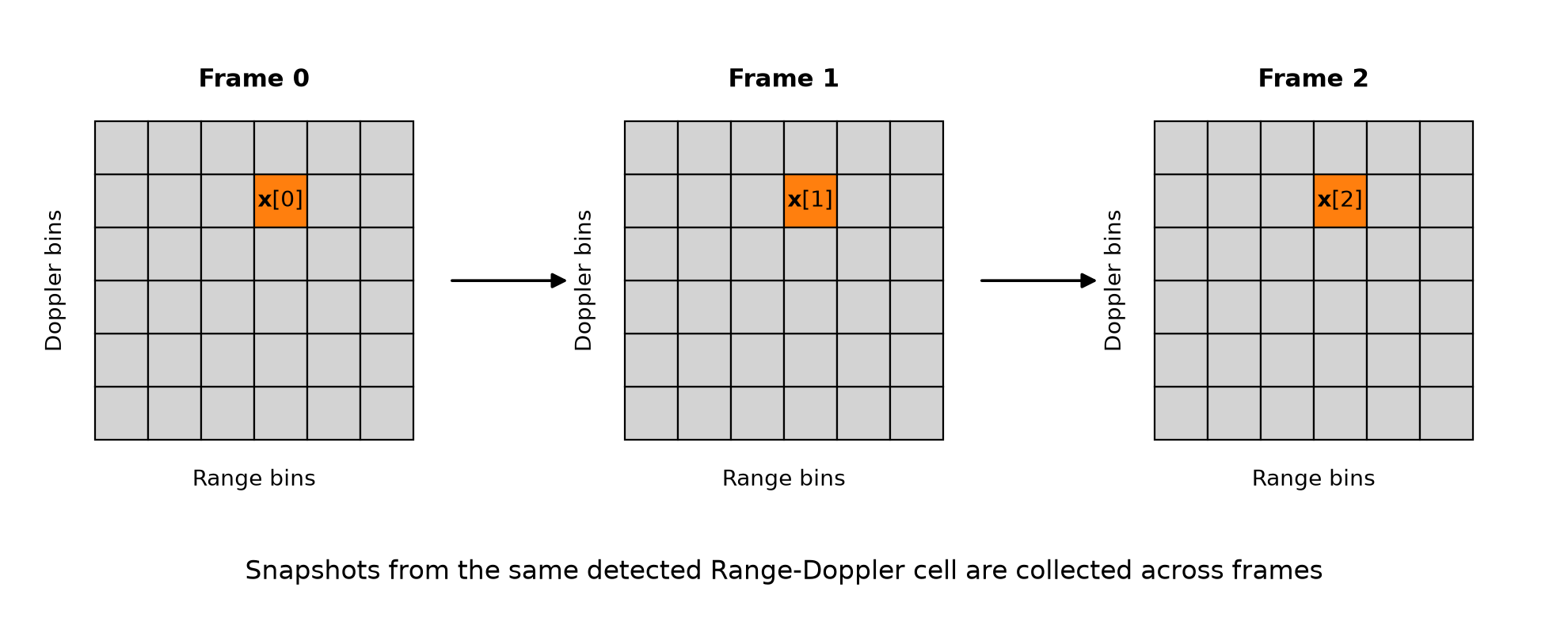
For $L$ collected frames, the sample covariance matrix is estimated as
$$ \hat{\mathbf{R}} = \frac{1}{L} \sum_{\ell=0}^{L-1} \mathbf{x}[\ell]\mathbf{x}^{H}[\ell], $$
where $\mathbf{x}[\ell]$ is the snapshot extracted from the selected Range-Doppler cell in frame $\ell$.
As a result, a valid covariance-based DoA estimate becomes available only after a sufficient number of frames has been collected.
Neighboring range and Doppler bins
Snapshots can be extracted from cells adjacent to the detected Range-Doppler cell within a single frame. The selection may be performed separately along the range axis or along the Doppler axis while keeping the other coordinate fixed.
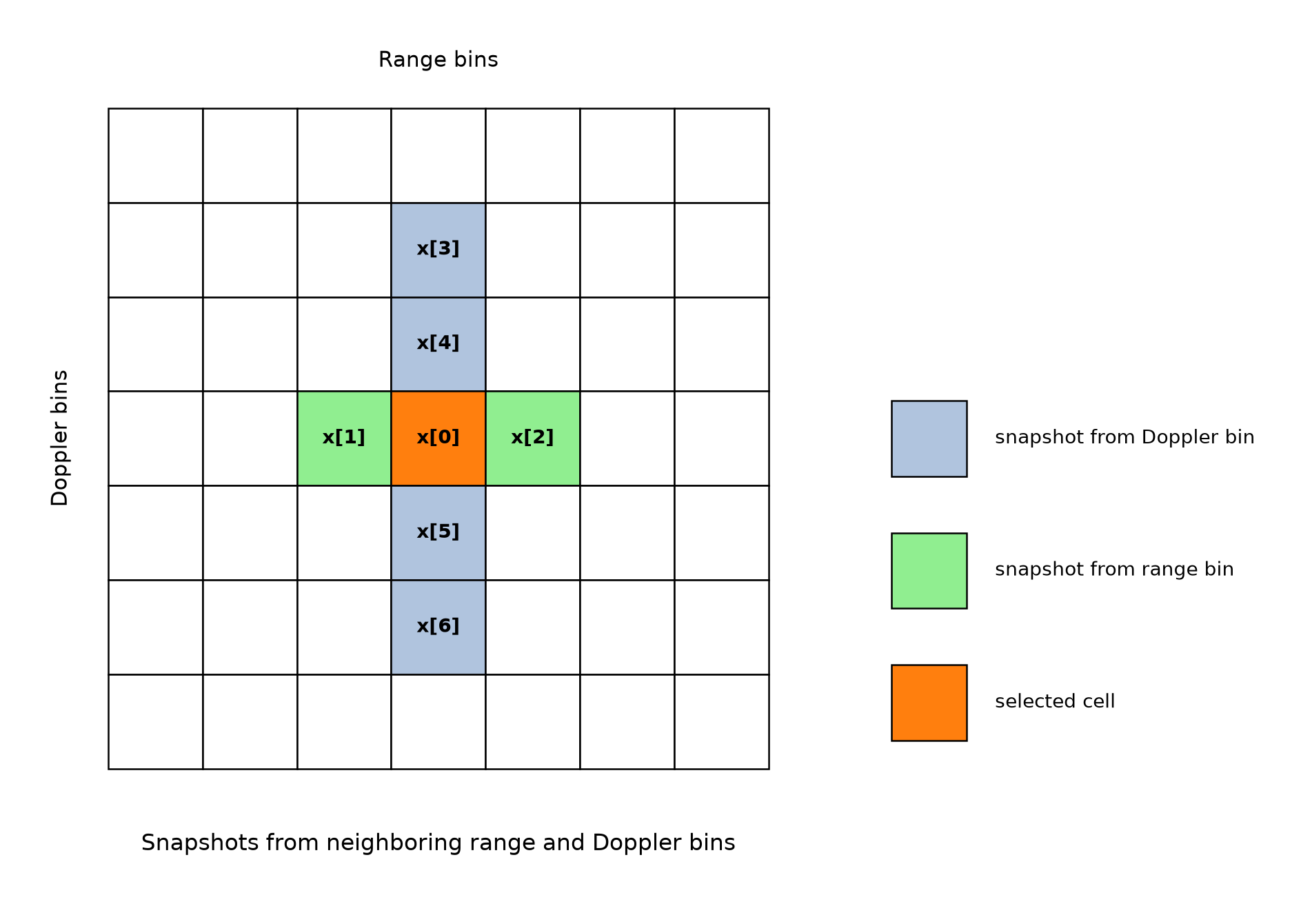
For $L$ selected cells, the sample covariance matrix is estimated as
$$ \hat{\mathbf{R}} = \frac{1}{L} \sum_{\ell=0}^{L-1} \mathbf{x}[\ell]\mathbf{x}^{H}[\ell], $$
where $\mathbf{x}[\ell]$ is the spatial snapshot extracted from the $\ell$-th selected range or Doppler bin.
This approach enables covariance estimation within each frame. However, neighboring cells should be selected carefully to ensure that they represent the same target response rather than unrelated signal components.
Range–Doppler neighborhood
Snapshots can be extracted from a local neighborhood around the detected Range-Doppler cell within a single frame. The neighborhood may include adjacent bins in both dimensions, or only along the range or Doppler axis.
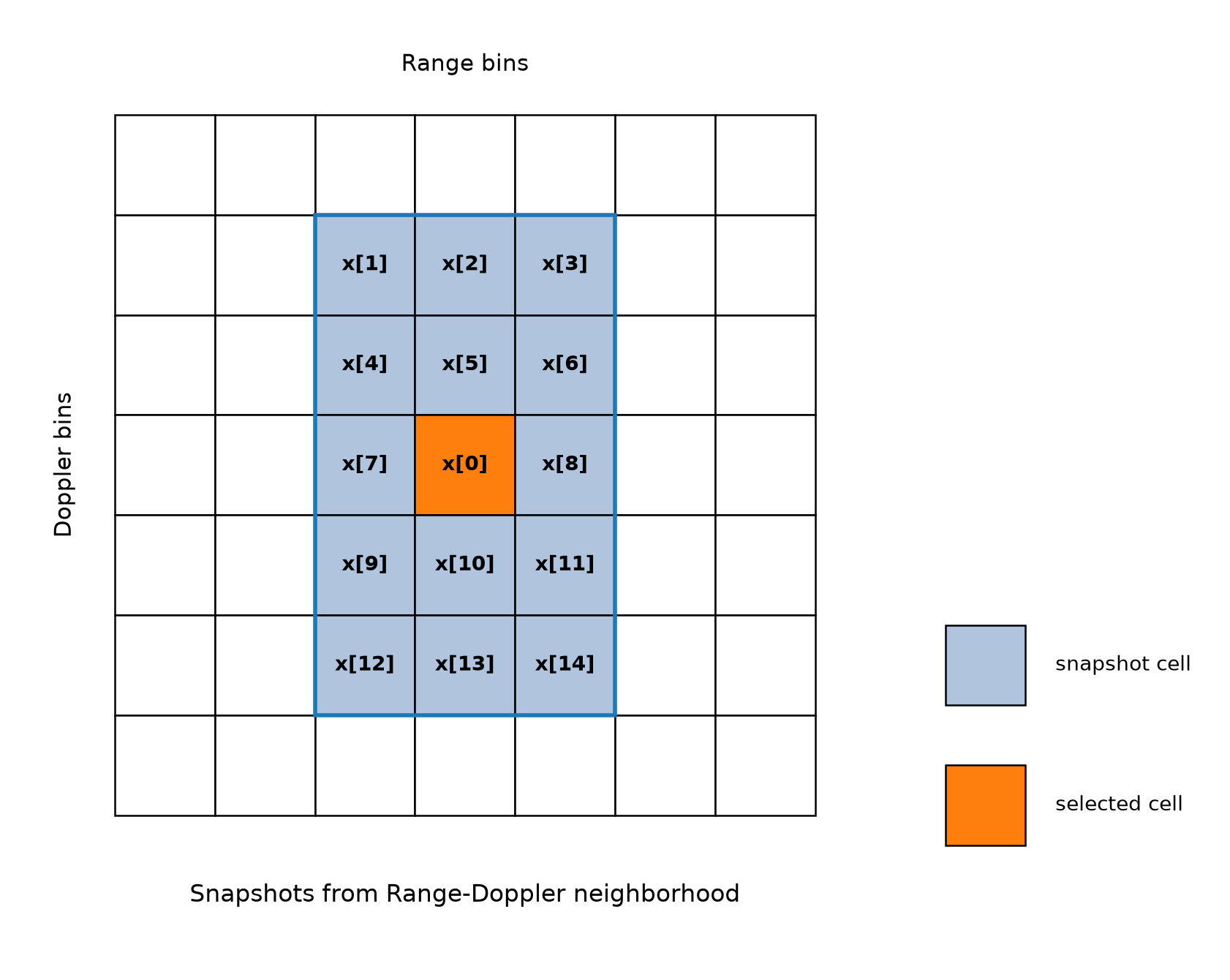
For $L$ selected Range-Doppler cells, the sample covariance matrix is estimated as
$$ \hat{\mathbf{R}} = \frac{1}{L} \sum_{\ell=0}^{L-1} \mathbf{x}[\ell]\mathbf{x}^{H}[\ell], $$
where $\mathbf{x}[\ell]$ is the spatial snapshot extracted from the $\ell$-th selected cell in the Range-Doppler neighborhood.
This approach allows the covariance matrix, and therefore the covariance-based DoA estimate, to be updated independently for each frame.
Overlapping subarrays
Spatial smoothing generates several snapshots from one detected Range-Doppler cell by dividing the original virtual array into shifted, overlapping subarrays. Each subarray contains a reduced number of antenna elements and contributes one spatial snapshot.
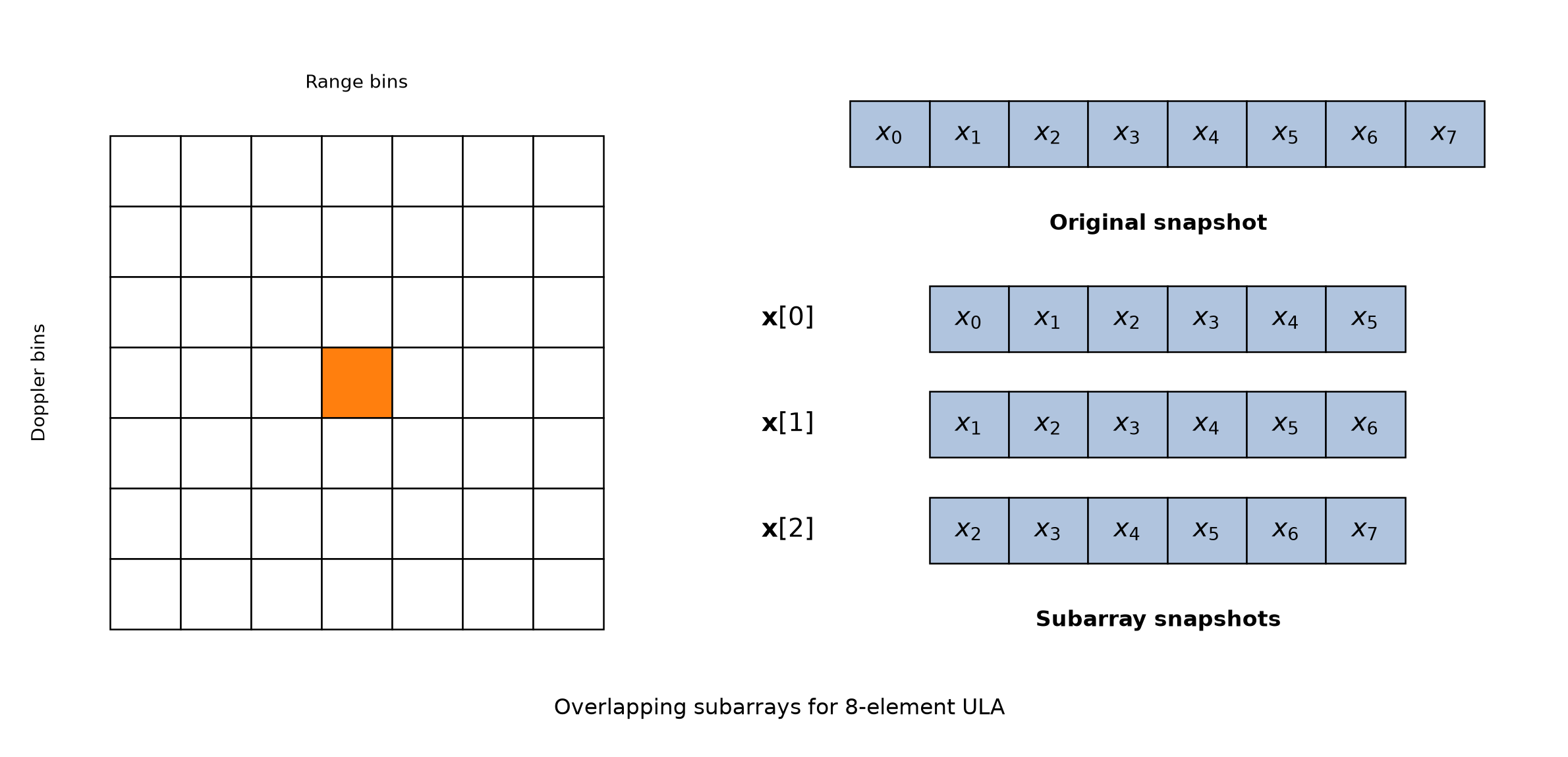
For $L$ overlapping subarrays, the sample covariance matrix is estimated as
$$ \hat{\mathbf{R}} = \frac{1}{L} \sum_{\ell=0}^{L-1} \mathbf{x}[\ell]\mathbf{x}^{H}[\ell], $$
where $\mathbf{x}[\ell]$ is the snapshot formed by the $\ell$-th overlapping subarray.
This method enables covariance estimation within a single frame, but reduces the effective array aperture because each snapshot contains fewer antenna elements than the original array.
Comparison of covariance snapshot extraction methods
A rigorous comparison of snapshot-extraction methods requires a more detailed analysis across different target scenarios and processing configurations. In particular, the Range-Doppler neighborhood method may require additional cell analysis and selection to ensure that the neighboring cells contain signal contributions from the same target scene
The figure below shows Bartlett, Capon MVDR, MUSIC, and ESPRIT results obtained from AWR2243 measurements. The static scene contains two corner reflectors located off boresight, around $45^\circ$, with an approximate lateral separation of $2\,\text{m}$.
For the one-snapshot-per-frame method, two frames are used, providing two snapshots. The Range-Doppler neighborhood method uses 15 snapshots from neighboring cells within one frame, while the overlapping-subarray method produces three snapshots from an eight-element virtual ULA using subarrays of six elements.
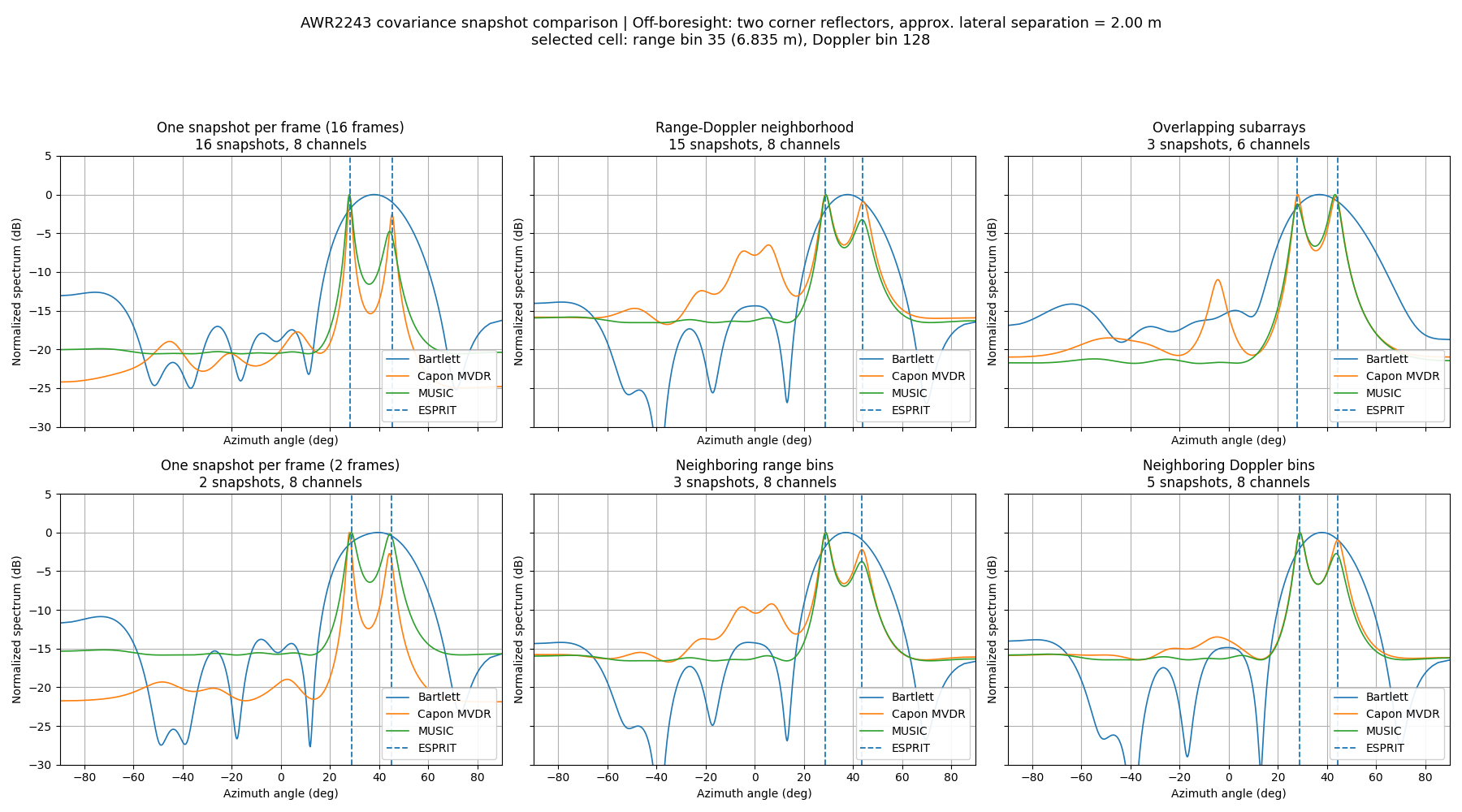
For this geometry, the Bartlett spectrum merges the two reflector responses into a single broad peak because its angular resolution is mainly limited by the effective array aperture.
ESPRIT returns nearly identical DoA estimates for all three snapshot-extraction methods.
Among the presented cases, the one-snapshot-per-frame method provides the clearest Capon MVDR response, with stronger target peaks and no pronounced parasitic peak.
The MUSIC estimates remain generally consistent across all three methods, although the detailed spectral shape depends on the snapshot set and the resulting covariance matrix.